News
NWO Vici grant for Akira Endo
- Friday, 27 February 2026
Time-traveling to galaxies of the past: creating a 3D map of the early Universe
When you look up at the sky at night, at the endless amounts of stars and constellations, you might begin to wonder about the origins of the Universe. And that is exactly what experimental astronomer Akira Endo, and his team, are trying to uncover. They are creating a 3D map of the early Universe, for which they’re developing a chip with tiny terahertz spectrometers, which are very small analytical instruments that measure the properties of far-infrared light. Akira is a researcher at the Terahertz Sensing Group, and he has received a Vici grant from the Dutch Research Council (NWO) for this study.
Discovering the young cosmic web
In the early Universe, the large-scale distribution of dark matter and galaxies was assembling into the cosmic web. Galaxies grew and merged, while stars formed vigorously. To learn more about the distant, dust-enshrouded galaxies in the early Universe, astronomers study infrared light that has traveled for billions of years before reaching Earth. Rather than relying solely on individually visible galaxies, astronomers can also study the faint glow emitted by many young galaxies. This widespread glow carries a hidden imprint of how matter was arranged in the early Universe. These studies show how fast galaxies are moving away from us and therefore how far away, and how old they are. But star formation and galaxy evolution in the early Universe have been observed only in small cosmic volumes. Akira Endo and team will reveal the cosmic large-scale structure and the cosmic star formation history with new observational techniques.

News
NWO Vici grant for Akira Endo
Time-traveling to galaxies of the past: creating a 3D map of the early Universe
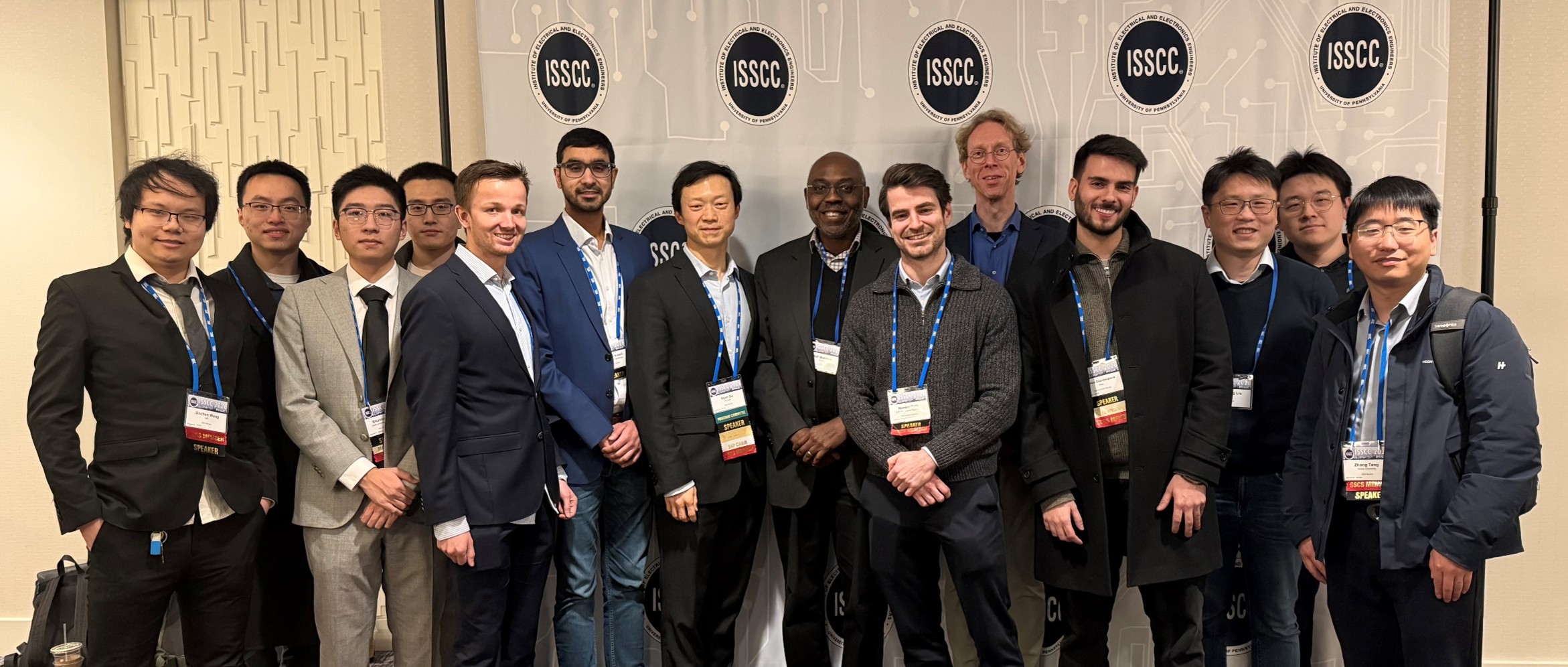
Record presence for the department at ISSCC 2026
At this year’s International Solid-State Circuits Conference (ISSCC) - the world’s leading conference on chip design (the Chip Olympics), TU Delft presented a record 14 papers and 1 forum talk, out of a total of 39 accepted EU papers.

Professor Kofi Makinwa appointed member of the KHMW
The Royal Holland Society of Sciences and Humanities (KHMW) has appointed Prof Kofi Makinwa, head of the Microelectronics department of TU Delft’s faculty of Electrical Engineering, Mathematics and Computer Science, as a Scientific member.